

The menstrual cycle is the monthly process your body goes through to prepare for a possible pregnancy. Even though periods are the most noticeable part, they're really just one phase of a longer cycle that's happening in the background all month long.
The Four Phases
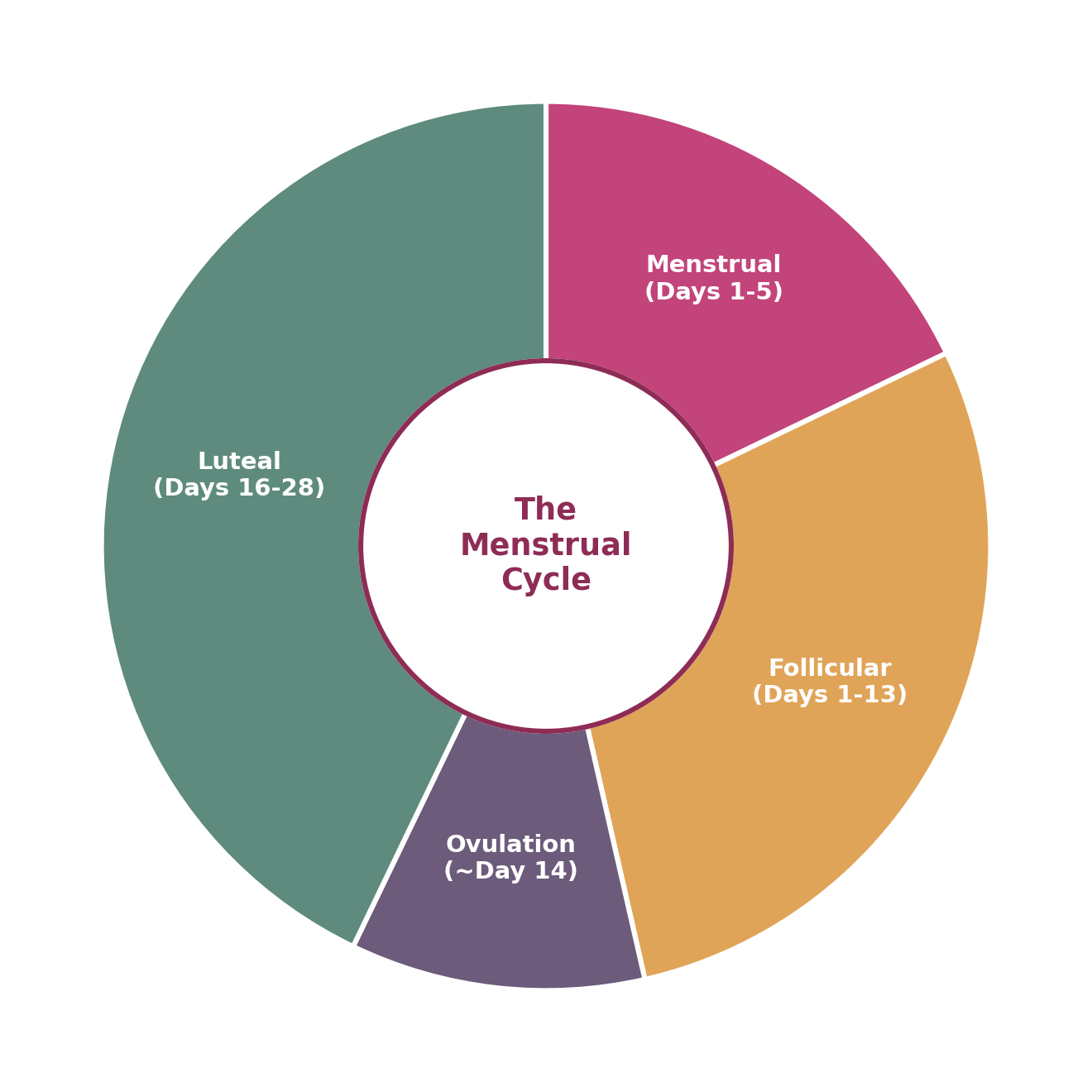
The four phases of the menstrual cycle.
- 1. Menstrual phase (Days 1-5 approximately): the uterine lining sheds, this is your period.
- 2. Follicular phase (overlaps with the period and continues after): the ovaries begin preparing an egg, and the uterine lining starts rebuilding.
- 3. Ovulation (roughly the midpoint of the cycle): a mature egg is released from an ovary.
- 4. Luteal phase (the two weeks or so after ovulation): the uterine lining thickens further; if no pregnancy occurs, hormone levels drop and the cycle begins again with a new period.
A cycle is counted from the first day of one period to the first day of the next. While 28 days is often used as the "textbook" average, a normal cycle can range anywhere from about 21 to 35 days, especially in the first few years after your first period, when cycles are often irregular while your body finds its rhythm.
Why This Matters for You
Understanding the cycle helps explain things that might otherwise feel random: why cramps happen around the same time each month, why your body temperature and appetite shift slightly through the month, and why the days leading up to a period can feel different from the rest. None of it is random. It's a pattern, and once you start tracking it (more on that in Part II), it becomes predictable and much less mysterious.
Chapter Recap
- The menstrual cycle is a repeating, roughly monthly process, not just "the days you bleed."
- It's driven by the rise and fall of estrogen, progesterone, FSH, and LH.
- Cycle length varies naturally from person to person and month to month, especially in the first couple of years.
In Part II, we'll focus on the moment you've probably been most curious about: your very first period, what leads up to it, and exactly what to expect.
PART II Your First Period
Educational Health & Safety Notice
Period Talk provides general educational health information only and is not a substitute for professional medical advice, diagnosis, or treatment. Always consult a qualified healthcare provider for personalized medical concerns.
Authority & Emergency: Aligned with evidence-based guidelines from international health organizations (ACOG, NHS, WHO, FOGSI). If you think you may be experiencing a medical emergency, seek urgent medical care or contact your local emergency service immediately.